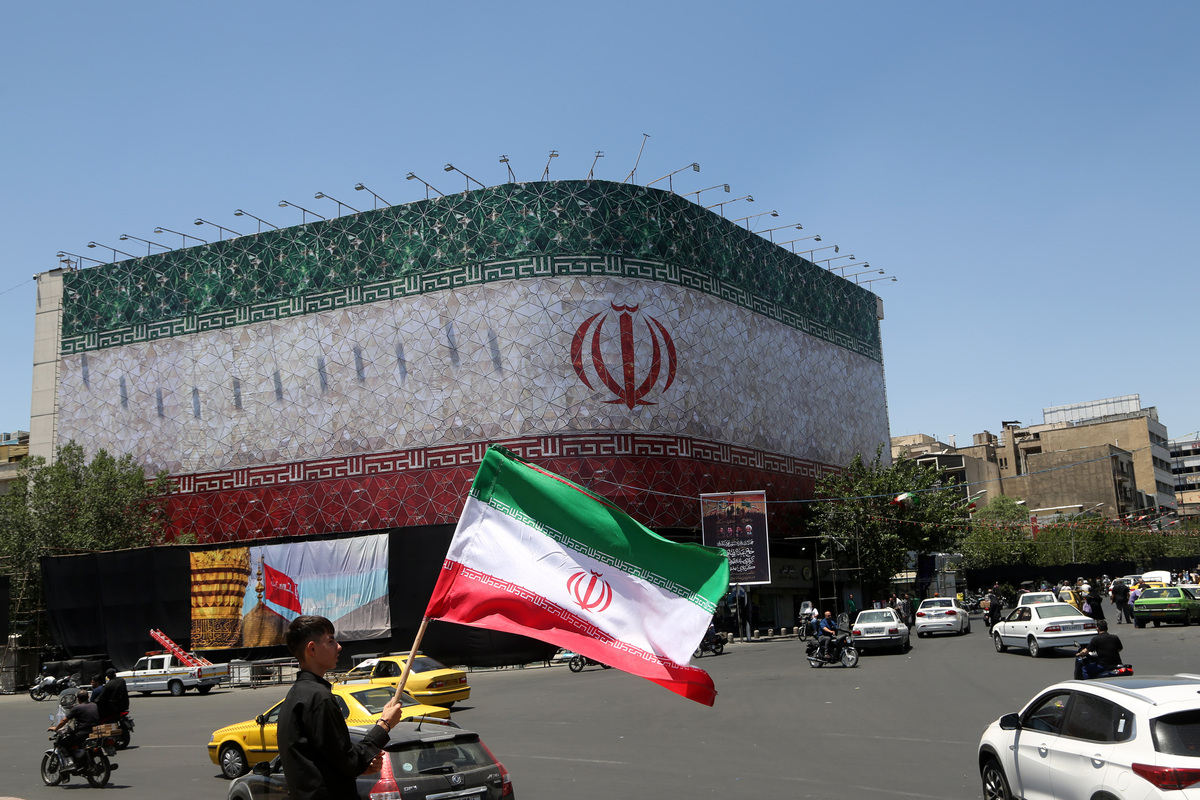
Iranian press review: Conflict revived Iran’s regional power, says anti-war analyst
Submitted by
MEE correspondent
on
Thu, 06/18/2026 - 11:05
Meanwhile, new details emerge of US missiles used for first time, first motorcycle licences issued for women, and economist warns of hyperinflation risk
A man in Tehran reads the Iranian daily newspaper Hamshahri bearing an image of the US president and the headline 'Gone with the wind', on 18 June 2026 (AFP)
Off
War renews confidence in regional alliances
Iranian analyst Mehrdad Ahmadi Sheikhani said the recent US-Israeli war on Iran has renewed support for one of the country's key regional policies of expanding its strategic depth.
Since the end of the Iran-Iraq war in 1988, Tehran has built ties with armed and political groups across the Middle East that share its ideological views. Iranian political and military leaders have long argued that these alliances help the country deter attacks by Israel.
That strategy came under growing criticism after Israel attacked Iran in June 2025, triggering a 12-day war. Critics argued that Iran's regional allies had failed to prevent the conflict and questioned the strategy's value.
In response, Sheikhani argued in the Shargh daily that support for the policy has grown within the establishment, pointing to the Lebanese group Hezbollah's backing at the start of the war in February, Iran's response to Israel's bombing of Beirut earlier this month, and the stance taken by Yemen's Houthis.
"Iran's attack on Israel in response to the attack on Dahieh was a redefinition of Iran's spheres of influence and strategic depth in the post-war period," he wrote. "While many had claimed in recent years that this approach was terminated, especially after the fall of Syria."
Sheikhani also placed the war in a broader historical context, arguing that it marked Iran's return to a level of power not seen for more than two centuries. Since the assassination of Agha Mohammad Khan Qajar in 1797, he said, Iran had gradually lost territory and influence through its conflicts with the Russian, Ottoman and British empires.
A supporter of a quick end to the war and negotiations with Iran's opponents, Sheikhani said the conflict was historic because Iran did not lose territory despite facing major foreign powers.
"One of the realities revealed by this war was the remarkable precision and planning of our defence," he wrote. "Before the war, many would not have anticipated that such capabilities existed. Today, they have given the country a level of deterrence that it has lacked since the killing of Agha Mohammad Khan."
24 US bullets for every resident of Lamerd
With the announcement of a deal between Tehran and Washington, officials have revealed more details about the destruction caused by the war in Iran.
Seyyed Moussa Mousavi, a legislator from the southern city of Lamerd, said the Precision Strike Missile (PrSM) used by the US on the first day of the war was equipped with a tungsten-fragment warhead.
'Israel is weaker': Israeli political class reacts angrily to the US-Iran peace deal
»
"These missiles exploded before hitting the ground, leaving no impact crater on the ground. Instead, each missile was transformed into 180,000 projectiles known as tungsten bullets," Mousavi told the IRNA news agency.
Earlier reports have confirmed that the latest versions of the PrSM were used in attacks on Iran, but they have not provided additional details about the warheads.
In one attack, PrSM struck residential areas and a sports hall, killing 21 people and wounding 150 others.
Mousavi said four such missiles were used on 28 February in the city of Lamerd, which has a population of about 30,000.
"In 35 seconds, around 720,000 bullets fell on the people of a small town. If we divide that number by Lamerd's population, it means that each citizen's share of [US President Donald] Trump's gift was 24 bullets," he said.
Women finally granted motorcycle licences
Zahra Behrouz Azar, Iran's vice president for Women and Family Affairs, said all procedures for issuing motorcycle licences to women have been completed, the Shargh daily reported. She announced that women would be able to obtain motorcycle licences within the next month.
Although no law in Iran explicitly prohibits women from riding motorcycles, the country's traffic police, which operate under the national police force, have long refused to issue licences to women. This is despite the fact that women have always been allowed to drive cars in Iran.
Behrouz Azar said the minimum age for obtaining a motorcycle licence will be 18. She added that licences would initially be issued to female motorcycle instructors and women officially involved in motorcycle sports through the country's motorcycle federation.
In recent years, the right to ride motorcycles has become a key women's rights issue in Iran. Despite repeated confrontations with traffic police and the confiscation of their motorcycles, many women continued to ride on the streets, publicly protesting against the restrictions.
Former bank chief warns of hyperinflation risk
Valiollah Seif, an economist and former governor of the Central Bank of Iran, has warned that the country could soon face hyperinflation as a result of international sanctions and the pressures created by the 12-day and recent war over the past year.
"Iran is not yet experiencing classic hyperinflation in the standard sense, but it is facing very high inflation and is close to the threshold of chronic instability and the risk of moving toward hyperinflation," he was quoted on Khabar online news.
Iranians greet deal to end war with relief, suspicion and uncertainty
»
According to Seif, five factors have increased the country's vulnerability to hyperinflation: persistent growth in liquidity, a structural budget deficit, sharp fluctuations in the value of the national currency, geopolitical shocks such as war and sanctions, and declining public trust in the national currency.
Moreover, he described the political situation following the US and Israeli attacks as a state of "no war, no peace".
Discussing the war's economic consequences, Seif said: "A situation of neither war nor peace, and without a lasting ceasefire, is highly damaging to the Iranian economy. It neither allows full stability nor confines the effects of war to a temporary shock. Instead, it creates a prolonged state of uncertainty."
He concluded by warning about the impact of this ongoing uncertainty: "Simply put, the economy does not die in this situation, but it is gradually eroded."
* Iranian press review is a digest of news reports not independently verified as accurate by MEE.
Iranian Press Review
News
Post Date Override
0
Update Date
Mon, 05/04/2020 - 21:19
Update Date Override
0