Lebanon-Israel ceasefire plans in doubt following Hezbollah's rejection
Submitted by
MEE staff
on
Thu, 06/04/2026 - 14:27
Hezbollah leader Naim Qassem rejects the outcome of talks, describing direct negotiations with Israel as 'shameful' for Lebanon. Plan is also criticised for lack of enforcement mechanism
Lebanese Ambassador to the US, Nada Hamadeh, right, and US Ambassador to Lebanon Michel Issa attend a meeting between Israeli and Lebanese delegations hosted by the US State Department in Washington, DC, 3 June 2026 (Reuters)
Off
A US-backed proposal to halt fighting between Israel and Lebanon has been met with immediate uncertainty, with Lebanese officials saying its implementation depends on Hezbollah’s approval and lacks a clear enforcement mechanism.
It followed two days of US-brokered direct talks between Lebanese and Israeli representatives, the fourth round of such negotiations to be held in Washington.
The talks produced a declaration calling for the implementation of a ceasefire and the creation of pilot zones in south Lebanon where the Lebanese Armed Forces would assume exclusive control, excluding all non-state actors.
But a senior official close to Lebanese President Joseph Aoun told Middle East Eye that the text “has no implementation mechanism” and that the entire process now hinges on Hezbollah’s response.
“The agreement is dependent on Hezbollah’s approval,” the official said.
According to the official, neither Hezbollah nor Parliament Speaker Nabih Berri, a key Hezbollah ally and long-time intermediary between the group and Washington, had been aware of the full content of the deliberations as they unfolded.
Once the text was ready, the Lebanese president sent it to both Hezbollah and Berri for feedback before Lebanon’s final position was conveyed to the United States, the official told MEE.
The official described the negotiations as “tough and hard”, saying the Lebanese delegation threatened to suspend the session after Israeli pushback against a full ceasefire.
The United States then proposed the pilot zones as a middle-ground formula, the official said.
The pilot zones would serve as an initial test for a broader security arrangement in south Lebanon, where the Lebanese army would deploy and assume control in selected areas before any expansion of the model.
Lebanon’s rulers have surrendered the country to Israel - this is no ceasefire
»
The same official said the US delegation insisted on condemning "Iran's attacks on countries in the region", which members of the Lebanese side viewed as an attempt to further separate the Lebanon-Israel track from negotiations involving Tehran.
Iran has made an end to Israeli attacks on Lebanon a key condition of its ongoing ceasefire with the US. On Monday, it suspended talks with Washington in response to Israeli threats to bomb Beirut.
"The US side insisted on repeatedly referencing Iran," the official told MEE, adding that this was widely understood as part of an effort to detach the Lebanon talks from the US-Iran negotiations.
Since a 17 April nominal ceasefire, Israel has continued to expand its military footprint in southern Lebanon through a combination of occupied territory, air strikes and evacuation orders. Areas covering roughly a fifth of the country have been brought under direct or indirect Israeli control, extending well beyond the buffer zone initially declared after the truce.
The declaration made no reference to a withdrawal of Israeli troops or an end to Israeli military operations in southern Lebanon.
Israeli Defence Minister Israel Katz said on Thursday Israel "will, for the time being, continue its fire and operations on the ground".
Katz said Israel would continue to dismantle Hezbollah "infrastructure in the area" and had "freedom of action, backed by the US to strike in Beirut in response to attacks on Israeli communities and territory".
'Shameful negotiations'
Hezbollah was not surprised by the outcome of the talks.
A source familiar with the group's thinking told MEE that Hezbollah had opposed the direct negotiations with Israel from the beginning because it believed it would inevitably lead to such a framework.
“From the first statement issued after the first joint meeting that initiated the direct negotiations path, we knew this is where the Lebanese state intended to go,” the source said. “That is why we were against this track from the start.”
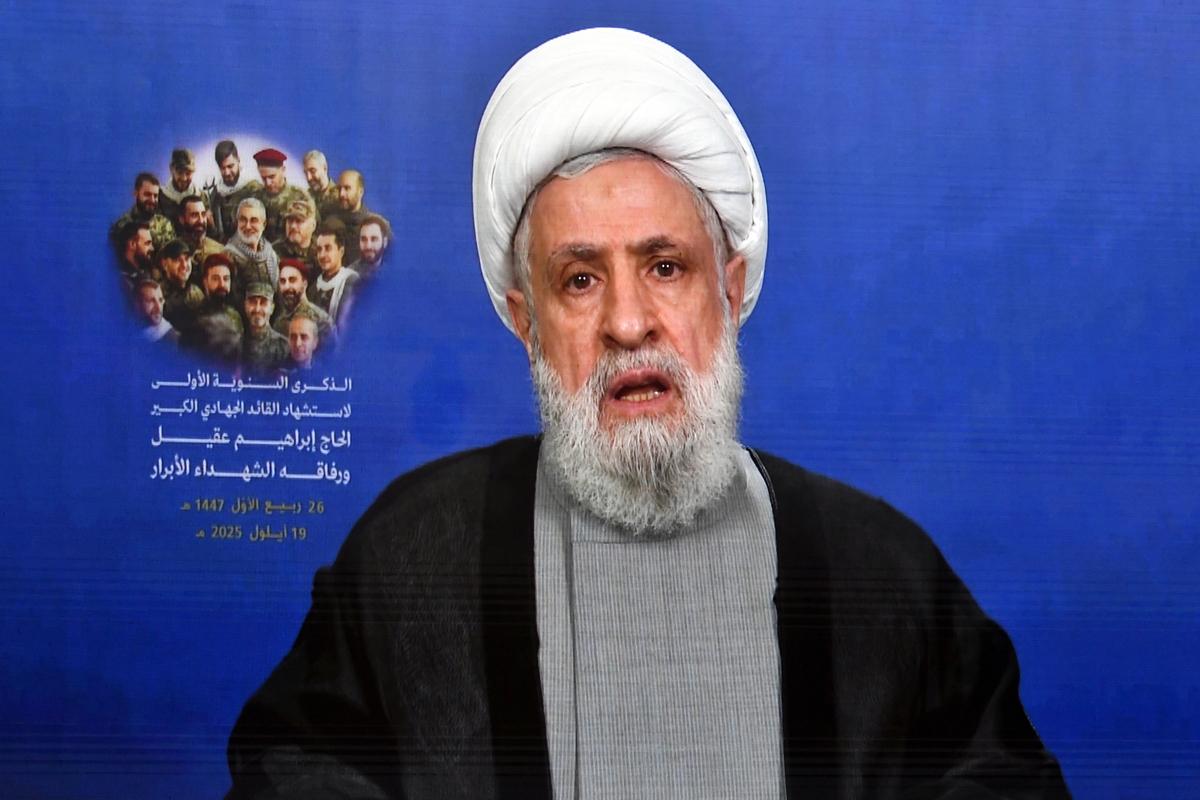
Hezbollah leader Naim Qassem later rejected the outcome of the talks, describing direct negotiations with Israel as "shameful" for Lebanon and dismissing any attempt to link a ceasefire and Israeli withdrawal from the south to the group's disarmament.
Qassem said a ceasefire must include southern Lebanon, where Israel has seized a self-declared security zone.
He added that towns in northern Israel would not be secure "as long as our villages are unsafe, bombed, destroyed, and our people are being killed".
For Hezbollah, the priority remains a complete halt to Israeli attacks across Lebanon and a full withdrawal from Lebanese territory before any internal discussion about its weapons can take place.
The US-backed proposal, however, places Hezbollah’s military activity and presence south of the Litani River at the heart of the ceasefire framework, setting up an immediate clash between Washington’s approach and the group's stated position.
A senior Lebanese official not involved in the negotiations told MEE that the proposal's wording was ambiguous.
“It is not clear to me if the ceasefire is simultaneous or sequential,” the official said.
The official said one section of the statement was particularly damaging for Lebanon, pointing to language endorsing US Secretary of State Marco Rubio’s assertion that Hezbollah is not only an enemy of Israel and the United States, but also “an enemy of Lebanon”.
Israel's colonisation of south Lebanon is already under way
»
“That paragraph is embarrassing to Lebanon, even if it states a US position,” the official told MEE.
The dispute underscores the narrow path facing Beirut. The Lebanese presidency is presenting the proposal as a final opportunity to secure a comprehensive ceasefire, while Hezbollah sees it as an attempt to extract through diplomacy what Israel has failed to achieve militarily.
It also exposes a central contradiction in the US-led process: Washington is seeking a state-to-state agreement between Lebanon and Israel, while Hezbollah, the most powerful military actor on the Lebanese side, remains outside the negotiations.
The Israeli and Lebanese delagations are expected to reconvene later this month for further political and security talks.
But without Hezbollah’s backing, Lebanese officials acknowledge that the proposal risks remaining a diplomatic framework with no clear way to implementation.
Israel's war on Lebanon
Beirut
News
Post Date Override
0
Update Date
Mon, 05/04/2020 - 21:19
Update Date Override
0