
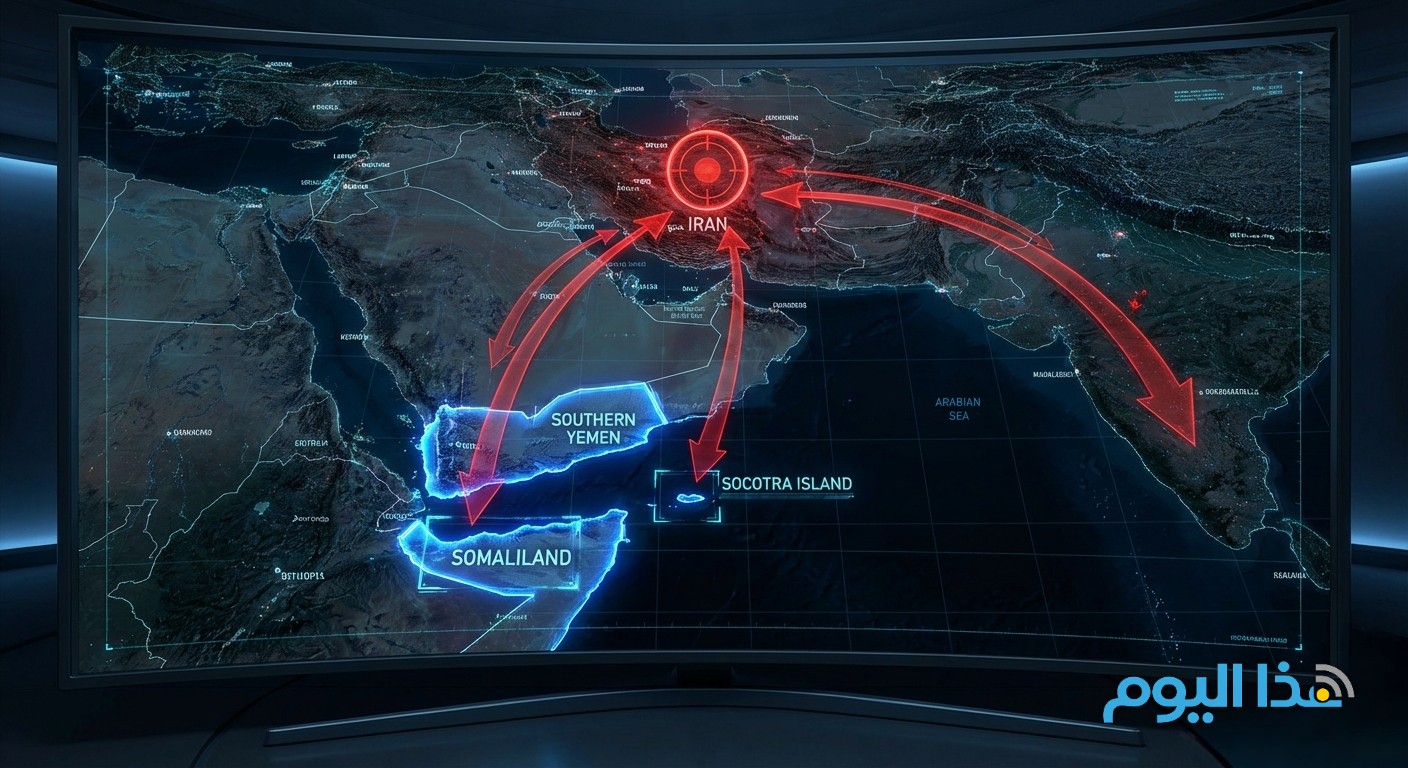
Amid the rapidly accelerating geopolitical shifts sweeping the Middle East, the scene is no longer limited to traditional, direct conflicts. It has moved toward a comprehensive redrawing of maps of influence and deterrence. In recent days, highly dangerous strategic moves have emerged, indicating that the coming confrontation with Iran will not be managed solely from the usual northern bases, but is being prepared from the “soft southern flank,” specifically through a new axis extending from “Somaliland” in the Horn of Africa, through Yemen’s strategic islands, and reaching deep into the Indian Ocean.
Analysts believe that this new engineering of the operational theater—led by Israel with Emirati funding and support—has not occurred without triggering a simmering and bloody conflict among supposed allies. Riyadh has found itself compelled to use “hard power” against its partner Abu Dhabi in Yemen, an unprecedented development that signals the collapse of old alliances and the emergence of a new and highly complex reality.

Attached Image
What is being discussed behind closed doors but not publicly announced is that the cornerstone of this new plan lies in a deal that surfaced in 2024, involving recognition of “Somaliland” as an independent state—a move that goes beyond diplomatic norms and serves direct military positioning.
Intelligence reports indicate that the price of this recognition is granting Israel an advanced air base and extensive intelligence influence in the region, with direct Emirati support.
Analysts say the primary objective behind establishing the Berbera base—operated by the UAE and used by Israel—goes far beyond symbolic presence. It is intended as an operational launch platform that allows Israeli fighter jets to strike targets in central and southern Iran with greater flexibility and shorter distances, bypassing geographical complications and dense air defenses along northern routes. At the same time, it provides a massive logistical advantage by reducing the complex need for aerial refueling. In practical terms, this means Tel Aviv has acquired a “southern claw” capable of reaching deep into Iran and even Iraq from unexpected angles.
Israeli-Emirati ambitions do not stop at striking Iran. They extend to establishing tight control over international maritime routes in the Red Sea and Bab al-Mandab by creating a strategic “pincer” to encircle the Ansar Allah group (the Houthis) in Yemen. While the Houthis control northern Yemen and its western Red Sea coastline, the Somaliland air base forms the opposing southern arm, placing the Houthis between two jaws of integrated naval and firepower dominance aimed at neutralizing them and preventing the closure of strategic straits. This also creates maritime deterrence against Egypt from its southern gateway, ensuring dominance over global trade and energy flows.
This expansion could not pass peacefully. It ignited an existential crisis with Saudi Arabia, which viewed the Emirati-Israeli penetration of its vital surroundings as a threat to its national security no less dangerous than Iran itself—especially with attempts to advance toward Yemen’s Hadramout and Al-Mahra provinces along Saudi borders.
Tensions peaked in an unprecedented military incident revealing the depth of the rift, when the Saudi Air Force carried out precise and devastating strikes targeting Emirati ships transporting military equipment for the Southern Transitional Council at the port of Mukalla in Hadramout. The strikes extended to include STC military convoys moving within the same province.
This Saudi strike was not merely a warning message, but a “bone-breaking” measure imposed by necessity. Riyadh understands that Emirati proxies gaining control over Hadramout and Al-Mahra—alongside presence in Socotra and Abd al-Kuri Island—would complete a southern encirclement of the Kingdom and turn these areas into rear bases for Israeli influence under Emirati cover. This constituted a red line Saudi Arabia defended with a severe ultimatum, granting Emirati forces 24 hours to withdraw immediately, while threatening to cancel the joint defense agreement and impose a comprehensive air blockade—forcing Abu Dhabi to comply and officially announce the withdrawal of its forces.

Attached Image
These field developments are complemented by political cover from Washington. Reports indicate that Israeli Prime Minister Benjamin Netanyahu has received a green light from U.S. President Donald Trump to launch a new military strike against Iran under the pretext of the growing ballistic missile threat, with clear hints that the next target may include Iranian nuclear facilities. Analysts believe Israel insists the strike must not be unilateral but part of a comprehensive joint U.S.-Israeli campaign.
This explains the urgent need to expand military footholds into the Horn of Africa and Yemen’s islands. Tel Aviv and Washington understand that a strike of this magnitude requires dispersing Iranian defenses by opening multiple fronts and securing alternative launch and control bases should the Gulf ignite and the Strait of Hormuz be closed. Here lies the importance of Somaliland and Abd al-Kuri Island, which are being rapidly transformed into advanced intelligence and military bases.
We are facing an extremely complex scene in which alliances are being reshaped based purely on existential interests. Saudi Arabia—leader of the Yemen coalition—found itself bombing its Emirati partner to prevent Israeli influence from taking root in southern Yemen, while the UAE and Israel press ahead with the Somaliland project to create a new geopolitical reality aimed at strangling Iran and its allies.
The Yemeni map—showing divided control between the Houthis in the north, the Southern Transitional Council in the south, and the internationally recognized government in the center—is no longer merely local frontlines. It has become a reflection of a larger international struggle, with each party seeking to seize strategic areas (Hadramout, Al-Mahra, Socotra) to use as leverage in the coming major regional war.
The region now stands on the edge of a volcano, where Israeli ambitions to strike Iran’s nuclear program intersect with Saudi fears of southern encirclement, in a zero-sum equation that could redraw borders and topple regimes—turning the Red Sea and the Horn of Africa into the next miniature global war theater.
On the parallel political front, Washington’s “operations room” was finalizing the legitimization of this new military theater. The pivotal meeting between U.S. President Donald Trump and Israeli Prime Minister Benjamin Netanyahu functioned as a mini “war council,” where Netanyahu appeared to successfully sell the “perfect pretext” to the new U.S. administration, presenting intelligence claims that Tehran had used recent months to rebuild and enhance its missile arsenal to a level posing an existential threat.
The American response was decisive, with Trump granting the “green light” for a devastating attack, stating: “If Iran is trying to build its military capabilities, we will have to knock those capabilities down again, and we will hit them very hard.”
What transpired behind the scenes in Washington clearly explains Israel’s desperation to control the Horn of Africa and southern Yemen. Netanyahu did not ask for a limited strike, but for a “comprehensive joint U.S.-Israeli campaign.” When asked about the limits of such a strike, he went beyond ballistic missiles and stated: “If it’s about nuclear [facilities], then quickly.”
Such a joint campaign necessarily requires a vast operational theater and secure rear bases beyond the reach of Iranian missiles targeting the north—roles prepared for Berbera base and the islands of Socotra and Abd al-Kuri as launch and support platforms for this major campaign.
Reinforcing the “zero hour” hypothesis are statements by Israel’s former defense minister, confirming that military action against Iran “could begin very soon.”
This timing—coinciding with the forced Emirati withdrawal from certain Yemeni positions under Saudi pressure, alongside military buildup in the Horn of Africa—suggests the region has effectively entered a countdown phase. What we are witnessing are early tremors of an approaching military earthquake, whose decision was made in Washington, planned in Tel Aviv, and whose battlefield stretches from the shores of Somalia to Iran’s reactors—fueled by alliances forming and others collapsing under the weight of major interests that recognize neither emotion nor neighborhood.
Strategic Affairs Editor
Hatha al-Youm