Shafaq News
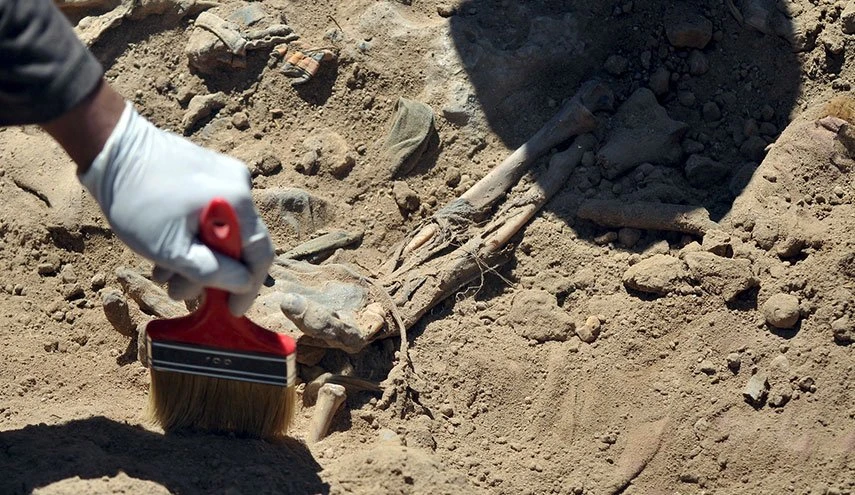
7,709 is the number of sets of human remains Iraq hasofficially recovered from its mass graves across all eras. The United Nationsestimates the total number of people buried in those graves at between 250,000and one million.
Iraq has a dedicated government directorate for mass graves,an annual national day commemorating its victims, and burial sites spanningfive distinct periods of violence across half a century. The bodies continue tobe counted, and the vast majority of remains have not yet been matched to aname or returned to a family.
The Saddam Era: 1968–2003
The largest concentration of mass graves in Iraq dates tothe Baath regime under Saddam Hussein, whose campaigns of political repression,ethnic cleansing, and genocide produced burial sites across the country'ssouth, center, and north.
The Anfal campaign of 1986–1989, directed against theKurdish population of northern Iraq, resulted in the forced disappearance ofmore than 180,000 people, according to the Kurdistan Regional Government'sMartyrs Foundation. The Halabja chemical attack of March 16, 1988, one of thelargest use of chemical weapons against a civilian population in history,killed more than 5,000 people in a single day. The Samawa desert in the southcontains mass graves filled with Kurdish women and children displaced duringSaddam's Arabization program; one site alone holds approximately 1,500 bodies,most killed at close range, according to Iraqi Ministry of Human Rightsdocumentation.
The 1991 Shia uprising, following the Gulf War, wassuppressed with mass executions across southern Iraq. The 8,000 men from theBarzan area killed in 1983, a case ruled by the Supreme Iraqi Criminal Tribunalto constitute genocide and a crime against humanity, remain only partiallyaccounted for, with some remains recovered from a mass grave in Samawa asrecently as 2019.
The sites from this era are the most numerous and the mostpolitically charged. The perpetrators were tried, but the victims were neverfully found.
The 2003 Invasion And Its Aftermath
The fall of the Baath regime in April 2003 opened thecountry's buried history to systematic documentation for the first time. Bymid-January 2004, 53 mass grave sites from the Saddam era had been confirmed,with early estimates suggesting the remains of 400,000 people across sitesdiscovered in the months following the invasion. Iraq's Ministry of HumanRights eventually confirmed 315 mass graves found since the US-led conflictbegan.
But the collapse of state authority produced new casualtiesalmost immediately. Sectarian armed groups, insurgent factions, and securityforces operating outside legal oversight contributed to a wave of killings inwhich bodies were routinely found in streets, rivers, and unmarked sites. UNAMIreported that 34,452 civilians were violently killed in 2006 alone, manybearing signs of execution-style killings, torture, and, in some cases,decapitation. The Baghdad Medico-Legal Institute received 30,204 bodies between2003 and mid-2006.
Dedicated mass grave sites from this period have beenidentified but remain incompletely excavated. The distinction between Baath-eraand post-2003 graves is a continuing source of dispute in some locations. Inthe recent case of a newly discovered site in western al-Anbar province, aprovince that bore the weight of both Baath-era repression and post-invasioninsurgency, a civil activist told Shafaq News that the file "cannottolerate speculation" and demanded a transparent investigation toestablish the timeline and the identity of the victims. The politics of who isburied where, and by whom, carry present-day stakes that complicate everyexcavation decision.
The ISIS Period: 2014–2017
The Islamic State's three-year territorial control ofnorthern and western Iraq produced the most recently documented and mostinternationally investigated mass graves in Iraqi history. A UN Human RightsOffice and UNAMI report documented 202 mass grave sites in the governorates ofNineveh, Kirkuk, Saladin, and al-Anbar, containing the remains of women,children, the elderly, disabled persons, and members of Iraq's armed forces andpolice.
No community suffered more disproportionately than theYazidis. More than 5,000 Yazidis were killed in the ISIS campaign that began inAugust 2014; more than 6,000 others, mostly women and children, were abductedand sold into sexual slavery. Nadia Murad, a survivor from the Yazidi villageof Kocho, became the international face of that campaign, winning the NobelPeace Prize in 2018 and testifying before the UN Security Council.
According to data from the Petrichor Human RightsOrganization, 95 mass graves have been located in the Yazidi stronghold ofSinjar district. Of these, 68 have been exhumed, recovering approximately 850bodies, of which only 96 have been identified. As of July 2025, more than 2,560Yazidis remain missing, according to the International Organization forMigration.
The Khasfa sinkhole south of Mosul is believed to containthousands of bodies and remains one of the largest and most technicallychallenging sites yet to be excavated. The Martyrs Foundation reports that 54ISIS-era mass graves have been exhumed from a total of 125 documented, with 71still untouched and 3,258 sets of remains recovered. The gap between what hasbeen found and what has been returned to families is wider still.
: A decade of suffering: Yazidis still seeking justice after ISIS atrocities
The Machinery Of Recovery
Iraq established two dedicated bodies to address the massgraves file: the Mass Graves Protection and Missing Persons Directorate,operating under the Martyrs Foundation and restructured under a November 2024law, and the Medico-Legal Directorate under the Ministry of Health, responsiblefor forensic identification. In its 2024 annual report, the Directoratedisclosed that it retrieved 677 sets of remains that year, obtained testimoniesand blood samples from 2,015 people with missing relatives, and succeeded inidentifying 168 remains from various sites across the country.
Between 2018 and 2024, UNITAD —the UN Investigative Teamestablished by Security Council Resolution 2379 in 2017— provided forensic,technical, and legal support that Iraqi domestic institutions could notreplicate alone. Over its mandate, UNITAD participated in the excavation of 68ISIS-related mass graves, digitized 20 million ISIS-related paper records, andsupported more than 300 requests for assistance from 21 countries for nationalinvestigations and prosecutions. Its annual budget of approximately $20 millionwas, by any measure, the primary financial engine of Iraq's excavation effort.
UNITAD ended operations in September 2024 after Baghdaddeclined to renew its mandate, amid disputes over evidence-sharing protocolsand Iraq's application of the death penalty in terrorism cases. With it wentnot only funding but forensic expertise, international legal reach, and theinstitutional credibility that had encouraged third-state cooperation.
As of October 2025, more than 316 mass graves have beenexhumed across Iraq, according to Zaidan Khalaf, human rights advisor to formerPrime Minister Mohammed Shia al-Sudani, speaking at the Fifth InternationalScientific Conference on the Genocide of the Kurdish People in Duhok. What hasnot been replaced is the capacity that made those exhumations possible.
: Inside Iraq's ongoing search for answers in ISIS mass grave
Why The Graves Stay Closed
The obstacles to completing Iraq's mass graves excavationsare institutional, financial, forensic, and political simultaneously, and theydo not operate in isolation from one another.
Funding is the most immediate constraint. With UNITAD gone,the $20 million annual budget it provided no longer exists, and the statefunding available to Iraq's two domestic directorates has never approached thatfigure.
DNA identification capacity is concentrated in a singlelicensed facility in Baghdad, a bottleneck that produces delays measured not inweeks but in years for families already waiting decades.
Victims' relatives face additional bureaucratic hurdles thatcomplicate access to compensation even when identification eventually succeeds.
In addition, some grave sites in Sinjar and the NinevehPlain lie in contested territory or areas where armed group presence restrictsaccess. The Khasfa sinkhole was classified by UNITAD as a high-risk siterequiring specialized equipment to prevent rock collapses during excavation,equipment that Iraqi authorities do not currently possess.
Political sensitivities compound the technical obstacles. Some Yazidi advocates have expressed concern about evidence files beingtransferred to the Kurdistan Regional Government, which a portion of the Yazidicommunity holds partially responsible for their vulnerability when ISIS attackedin August 2014, a charge the KRG contests.
The question of institutional accountability for theconditions that enabled the massacre is not resolved, and it shapes who trustswhom to handle the evidence of its aftermath. The al-Anbar dispute illustratesthe same dynamic at a different scale: the civil activist who spoke to ShafaqNews called the mass graves file in that province "one of the most painfulhumanitarian issues" in Iraq and warned explicitly against itspoliticization.
The UN estimates that between a quarter of a million and onemillion people disappeared in Iraq over the last half-century. Against thatscale, 7,709 recovered sets of remains, spread across eras, directorates, andpolitical cycles, is not a record of progress. It is a measure of what remainsto be done by institutions that have just lost their most capable partner, in acountry whose political class has not yet demonstrated the will to replace it.
Written and edited by Shafaq News staff.