Shafaq News
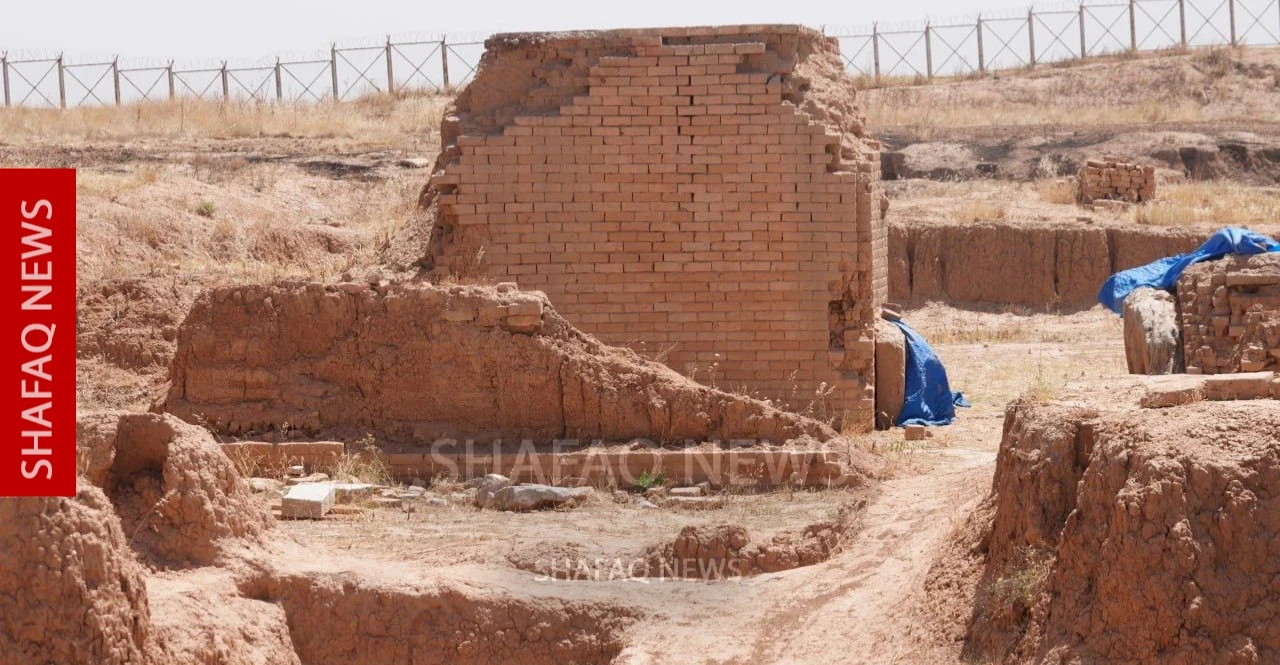
Walking into the ruins of Nimrud, an ancient Assyrian capital in Iraq's Nineveh province, Shafaq News' lens paused to take in what remains of one of the great civilizations in history. To the right stood a winged bull statue, defying the passage of time; ahead lay the throne room of King Ashurnasirpal II, once lined with carved stone slabs recording his battles, building projects, and the foreign delegations he received.
Nimrud wasbombed and ransacked by ISIS, the militant group that seized large parts ofIraq and Syria between 2014 and 2017, yet traces of that civilization still liescattered among the rubble, telling the story of a people who have preservedtheir heritage across the centuries. What stands out most are the carvings onthe stone and the inscriptions that remain vivid despite the passage of time.
Ruwaid Mowaffaq, director of the antiquities and heritage department, told Shafaq News that Nimrud, which sits on the eastern bank of the Tigris River, about 35 kilometers (22 miles) south of Mosul, ranks among the most important cities of ancient Iraq. It served as the second capital of the Assyrian Empire under King Ashurnasirpal II in the ninth century BC, functioning as a major political and military hub for the Assyrian state.
Mowaffaq saidthe city sustained severe damage while ISIS controlled the area between 2014and 2016, when the group destroyed its palaces and ancient sculptures withexplosives and bulldozers —chief among them the winged bulls and carvings ofthe Northwest Palace— inflicting major losses on Iraqi and world heritage.
“Nimrud is one of the most internationally recognized archaeological sites in Iraq, with artifacts from the city on display in 76 museums around the world,” he said, pointing out that its sculptures represent the height of Assyrian art in both precision and craftsmanship.
According toMowaffaq, the site has seen extensive rehabilitation work in recent years withsupport from international organizations, which helped train Iraqi specialistsand supply equipment for conservation and documentation. Parts of the city,however, still need further infrastructure work before it can fully open tovisitors.
Nimrud is hometo several major Assyrian palaces, including the Northwest Palace of KingAshurnasirpal II and the palaces of Shalmaneser III, Adad-Nirari,Tiglath-Pileser III, Sargon, and Esarhaddon, alongside the southeast palace ofKing Ashur-etil-ilani. The site also contains the city's well-known ziggurat,temples dedicated to the deities Nabu, Ninurta, Ishtar, and Kula, and FortShalmaneser, the largest structure in the ancient city.
: 150,000 archaeological sites, 556 tourists: Iraq's oil economy explains the gap
Qais Rasheed,an archaeological researcher, told Shafaq News that the footage ISIS releasedof its fighters smashing Mosul's antiquities was among the most painful imagesnot only for archaeologists but for all Iraqis, who watched part of theirhistorical memory targeted in front of the world.
“The real paincame when I stood in person before the destruction, walking among the rubble,examining what remained of the carvings that once lined the royal halls, andfinding a broken stone fragment bearing part of an image of an Assyrian kingseated on his throne. I lifted it carefully, studied it at length, then set itback in place to restore some of the dignity stripped from history.”
Rasheed said Nimrud is one of four historic Assyrian capitals, alongside Ashur, Nineveh, and Khorsabad, and was among the most important political and cultural centers in the empire. He said ISIS fighters cut many of the stone slabs apart with power saws to steal and smuggle out sections, blew up whatever could not be moved using barrel bombs, and filmed the destruction as propaganda. The campaign extended beyond Nimrud to the Nabi Yunus shrine, the al-Hadba minaret, and numerous other sites across Nineveh province, alongside organized looting.
He considered the extremist ideology behind ISIS treated ancient civilizations as"polytheistic" and therefore subject to destruction, the same logicthe group applied earlier in Syria's Palmyra before it seized Mosul. He addedthat antiquities trafficking was ISIS's second-largest source of funding afteroil, with investigations uncovering an extensive tunnel network beneath NabiYunus and other sites used for illegal digging and smuggling, alongside similarviolations in al-Anbar, Kirkuk, and Saladin.
: Assyrian palace excavated in the ancient city of Nimrud
Written andedited by Shafaq News staff.