INA - BAGHDAD
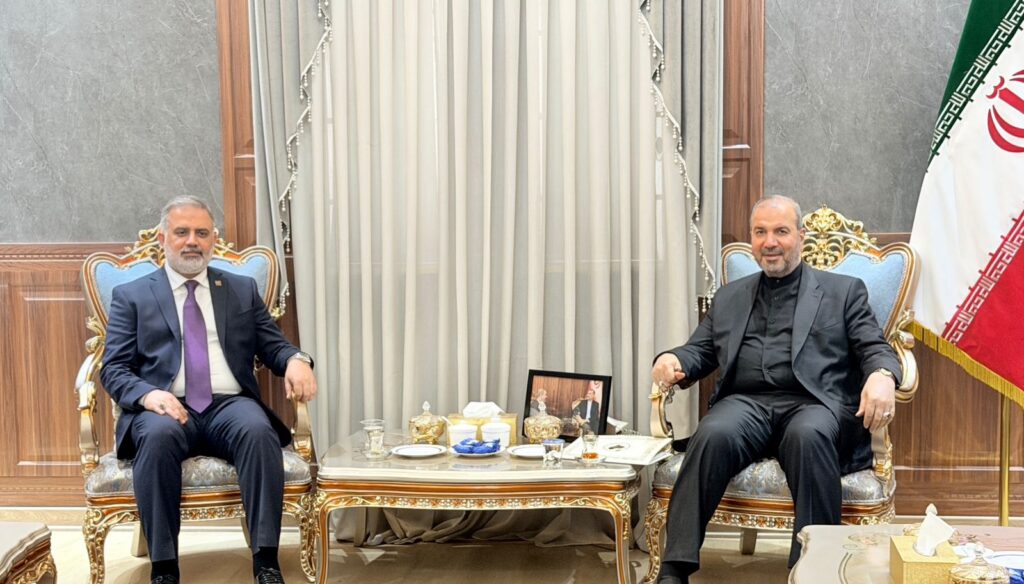
The Ambassador of the Islamic Republic of Iran to the Republic of Iraq, Mohammad Kazem Al-Sadiq, affirmed the deep historical, cultural, and religious ties that bind the Iraqi and Iranian peoples, “the relationship between the two countries transcends the lifespan of governments," he said.
Al-Sadiq reviewed several regional and domestic issues, foremost among them border security and the fight against terrorism. “Tehran's respect for Iraqi sovereignty and for any decision the government makes regarding the state's monopoly on the use of force,” he highlighted in a thorough interview with the Iraqi News Agency - INA.
Iraqi-Iranian Relations
"The new Iraqi Prime Minister, Ali al-Zaidi, was chosen as a result of the Coordination Framework's decision, and the Islamic Republic of Iran has always declared its respect for any outcome reached by the Coordination Framework,” Al-Sadiq stated.
He referred to the relationship between the Iraqi and Iranian peoples as ‘always been intertwined historically, culturally, and religiously,’ and on this basis, the two countries see a clear horizon for the relationship that transcends the lifespan of governments. "Iran is ready to further develop relations with the friendly and brotherly Republic of Iraq in all areas, particularly under the al-Zaidi government,” he said, expressing his hope for "the implementation of previous agreements in various economic, political, cultural, and security fields."
“Counterterrorism, border security, environmental issues, trade development, the Arba'een pilgrimage, and consular matters between the two sides are among the most prominent areas of cooperation between the two countries," he noted.
Resistance Factions
Al-Sadiq underscored that "we see resistance as the Iraqi people's choice in responding to and confronting terrorist gangs, especially Daesh. We also see it as a natural reaction of a conscious and vigilant people against occupation and foreign aggression. Iran respects the Iraqi people's right to defend themselves."
The Participation of Factions in the War
Iraqi factions in the war waged by Iran against the United States and Israel, Al-Sadiq said, "The Islamic Republic of Iran fought the (Zionist-American enemy) with strength and power, forcing it to submit. Iran did not request intervention from any party because it did not need any."
The Martyrdom of Sayyid Khamenei
"The beginning of the war witnessed the assassination of the martyred leader, Ayatollah Sayyid Ali Khamenei, and his family by the United States and the Zionist entity. This crime is a blatant violation and a dangerous precedent. The martyrdom of Sayyid Khamenei saddened not only the Iranian people but also all free peoples and souls who reject injustice and arrogance," he expressed.
Restricting Weapons to the State
The Iranian ambassador emphasized that "this is an internal Iraqi matter, and we respect any decision the Iraqi government makes in this regard. We believe that attention should be paid to the reasons that drive armed factions in Iraq to want to retain their weapons, and that their voices should be heard. Their concerns and fears must be addressed."
Attacks Against the Gulf
Regarding the accusations that attacks were launched from Iraqi territory against Gulf states and allegedly carried out under Iranian direction, Al-Sadiq indicated that "these issues require further investigation and study. The Iraqi government has announced that it is conducting investigations into them."
“The Iraqi government also possesses various documents regarding violations of its airspace and has submitted them to the United Nations. Accusing resistance factions of being subservient to or under the influence of a particular power is an insult to the very logic of resistance and its legitimate causes," he highlighted.
The Repercussions of Iranian-US Relations on Iraq
Al-Sadiq explained that "the war has affected the entire region. The United States is the actor that disrupted the regional order and its stability. The presence of US troops in Iraq makes its security and stability vulnerable to regional conflicts."
"We have a very good relationship with the friendly Iraqi people, and this relationship is flourishing at all levels. This interaction is certainly different from that with other countries, as Iran and Iraq will not refrain from helping each other. Dialogue leads to bringing viewpoints closer, and Iraq, as a neighboring country, possesses this capacity to help serve the interests of the region."
Hezbollah
Al-Sadiq denied claims that Iran had abandoned Hezbollah during its negotiations with the United States, emphasizing that "Lebanon has always been an integral part of the Islamic Republic of Iran's positions in negotiations with the United States, and that a ceasefire on the Lebanese front is linked to a ceasefire in the Gulf and Iran."
"Iran does not forget its Lebanese brothers and does not leave them alone. The memorandum of understanding recently signed between Iran and the United States explicitly included the issue of a ceasefire in Lebanon," he said.
Iran's International Relations
"Iran welcomes the resolution of disputes and the elevation of relations among the countries of the region," he stressed, recalling Tehran's Hormuz Peace Initiative, which “aims to establish sustainable security in the region through dialogue and the removal of misunderstandings.”
Iranian Gas
The Iranian Ambassador explained that "the US banking and financial sanctions imposed on Iran are the main reason for the problems Iraq faces in paying its dues to Iran. Based on the unilateral policies of the United States, normal payment systems are disrupted, and Iranian funds in the Iraqi banking system are effectively frozen."
“Breaking this vicious cycle requires striving to escape US banking hegemony and reduce dependence on the US dollar. A path that other countries around the world have begun to gradually follow,” he pointed out.
Joint Industrial Arenas
“There is a joint economic committee that meets annually between the two countries. There are programs underway that will enable the two countries, with the activation of their joint committees in the field of joint industrial zones, to take practical steps in this direction,” he noted, indicating that “the Iranian side also proposed activating this issue in some Iraqi governorates.” He expressed his hope that “it will be finalized during the meeting of the joint committee between the two countries.”
Iraqi Students
Al-Sadiq confirmed that “74 Iranian universities are included in the list of universities recognized by the Iraqi Ministry of Higher Education and Scientific Research. The Iraqi Ministry of Higher Education has established a specific system for evaluation and accreditation based on recognized international rankings.”
“About 10 Iranian universities were introduced to the Iraqi Ministry of Higher Education and Scientific Research through the Iranian embassy in Iraq,” he said.
The Ambassador underscored, saying, “The existence of a special Iraqi mechanism for graduates from unrecognized universities depends on passing a scientific evaluation exam at an Iraqi university before accreditation is granted.”
“The Islamic Republic of Iran maintains – under all circumstances – its readiness to defend the country, whether in times of war or in times of peace,” he concluded.