Shafaq News
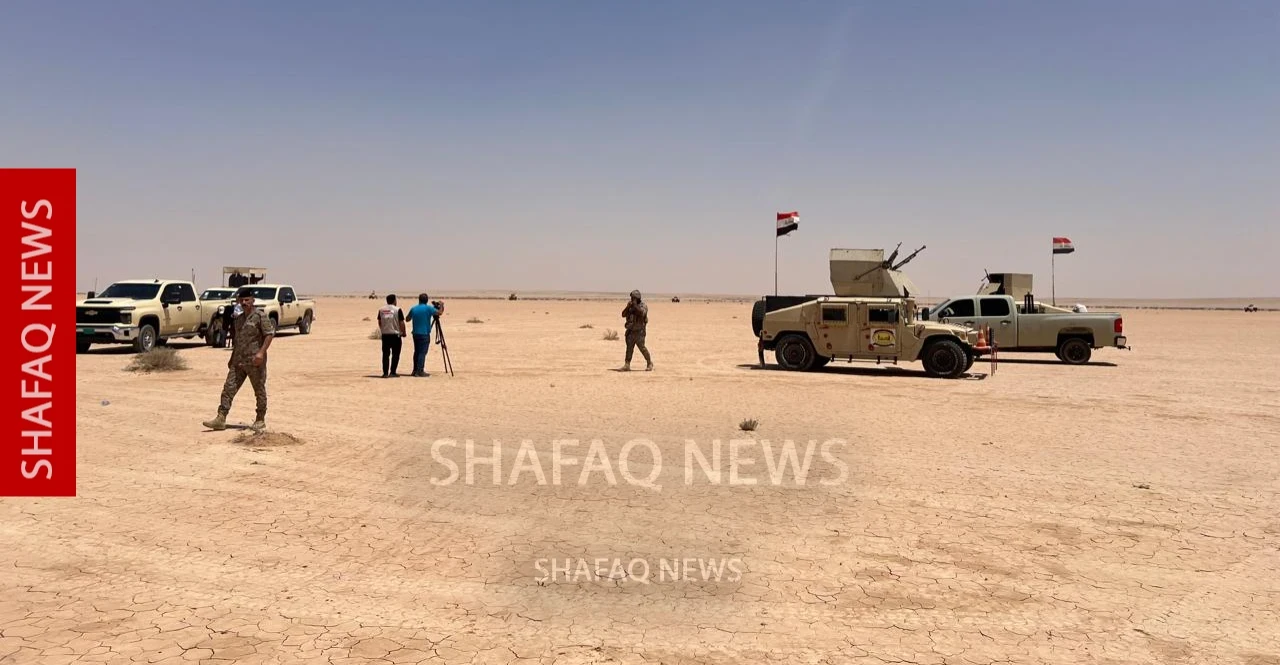
Stretchingacross Iraq’s western horizon, where paved roads fade into vast expanses of barrenland, the country’s western desert plateau remains one of its most challengingand strategically sensitive regions.
The area, whichcovers roughly 168,000 square kilometers, nearly 40% of Iraq’s territory, haslong posed a complex security and geographic challenge for successive Iraqigovernments. It extends from Al-Anbar province to Nineveh province and acrossthe deserts of Karbala and Najaf to the borders with Saudi Arabia, Syria, andJordan. The region’s rugged terrain, deep valleys, natural caves, and sparsepopulation have historically provided favorable conditions for militant groups,smuggling networks, and other illicit activities.
Locations suchas Wadi Horan, Wadi Al-Abyadh, Al-Nukhaib, and Wadi Humair have becomesynonymous in Iraq’s security landscape with insurgent activity andcross-border smuggling. More recently, the region drew renewed attentionfollowing international reports alleging the existence of secret military sitesdeep inside the western desert during the recent Israel-Iran conflict.
A PersistentSecurity Burden
The westerndesert has never been merely an uninhabited expanse. In 2017, even if Iraqiforces recaptured territory from ISIS, Wadi Horan in Al-Anbar remained one ofthe group’s most significant strongholds.
Militaryofficials at the time noticed that ISIS fighters used the interconnectedvalleys and cave systems near the Iraqi-Syrian-Jordanian border triangle tolaunch attacks on highways, military positions, and tribal communities.
Although Iraqdeclared military victory over ISIS at the end of 2017, the threat did notdisappear. Instead, the group adapted its tactics, shifting from territorialcontrol to what Iraqi security authorities describe as “flexible cells,” small,mobile units capable of operating across remote desert terrain.
The continuingthreat became evident during truffle harvesting seasons in Al-Anbar andAl-Nukhaib, when several kidnappings and killings targeted civilians searchingfor desert truffles in isolated areas. The Iraqi Counter-Terrorism Service saysthat ISIS remnants increasingly relied on kidnapping for ransom after losingcontrol of their former territories.
The issueresurfaced in March 2023 when ISIS militants reportedly burned two civilians todeath and abducted three others in the Al-Nukhaib desert southwest of al-Anbar,renewing concerns about the existence of militant hideouts and logistical basesin remote desert areas.
The DesertDilemma
Securityconcerns in Iraq’s western desert have expanded beyond ISIS activity.
In recentmonths, domestic debate intensified after American and Israeli media reportsalleged that secret military facilities inside Iraq’s western desert had beenused during the conflict between Israel and Iran.
While Baghdaddenied the presence of any unauthorized foreign military bases or forces onIraqi territory, the reports prompted security agencies to launch one of thelargest military deployments and search operations in the region in recentyears.
On May 18,2026, Iraqi armed forces launched a large-scale operation covering the desertsof Al-Anbar, Najaf, Karbala, and western Nineveh, involving airborne specialforces, army aviation units, and the Iraqi Air Force.
Officials toldShafaq News that the operation was intended to pursue remaining terrorist elements,secure remote areas, and prevent potential security breaches; however, theyviewed it as carrying a broader message about Iraqi sovereignty amid growingscrutiny over alleged undeclared military activities in the western desert.
Technology ReshapesDesert Security
Faced withevolving threats, Iraq’s Ministry of Defense stresses that it has adopted a newsecurity approach toward desert operations.
Major GeneralTahseen Al-Khafaji, director of media and moral guidance at the ministry, toldShafaq News that Iraq’s vast desert regions, particularly in Al-Anbar, Nineveh,Karbala, Najaf, and areas extending toward Al-Muthanna province, remaingeographically challenging and can serve as havens for smugglers and terroristnetworks.
“To addressthose risks, the ministry has established specialized desert-combat regimentsdeployed under the Al-Jazira, Al-Anbar, Western Nineveh, and Karbala OperationsCommands, supported by intelligence-gathering capabilities and continuousaerial surveillance.”
Al-Khafaji statedthat military and security intelligence agencies, special forces units, armyaviation, and airborne formations now operate within an integrated framework tomonitor suspicious activity. “The deployment of thermal cameras and advancedsurveillance systems has provided an almost complete picture of movementsacross the desert.”
Network of 950Surveillance Cameras
SaqrAl-Muhammadawi, a member of Iraq’s parliamentary Security and DefenseCommittee, observed that the country has significantly expanded itsborder-monitoring infrastructure in recent years.
Speaking toShafaq News, Al-Muhammadawi said more than 950 thermal and smart surveillancecameras have been installed along Iraq’s borders with neighboring countries,covering more than 90% of sensitive border areas and linking them tocommand-and-control centers that monitor activity in real time.
Proactivesecurity operations now extend well beyond border zones into the deserts ofAl-Anbar, western Nineveh, Najaf, Karbala, and the desert triangle connectingNineveh, Saladin, and al-Anbar provinces.
“Theseoperations focus on searching valleys, caves, and abandoned shelters,destroying weapons caches, and disrupting supply routes used by extremistcells.”
“The threat haschanged fundamentally,” Al-Muhammadawi stressed, adding that ISIS is no longerattempting to control cities or territory. “The danger now comes from smallcells of three or four individuals exploiting valleys and open terrain tooperate.”
Security andDevelopment
Alaa Al-Nashou,a security and strategic affairs expert, told Shafaq News that protecting thewestern desert requires a comprehensive strategy combining military deployment,intelligence capabilities, regional cooperation, and engagement with localcommunities and nomadic tribes, whose knowledge of desert routes can beinvaluable.
He alsoemphasized the importance of transforming the desert into a productive economicspace through agricultural, industrial, and investment projects, arguing thatdevelopment can help reduce the security vacuum that has historically enabledillegal activities.
Security expertAdnan Al-Kinani noted to Shafaq News that border and desert regions have longserved as operational zones for armed groups, warning that without sustainedeconomic development, these remote areas will remain vulnerable to exploitationby militant organizations, smuggling networks, and other actors seeking to takeadvantage of the region’s vast and difficult terrain.
: Israel's secret base in Iraq: what happened in the western desert
Written and edited by Shafaq News staff.