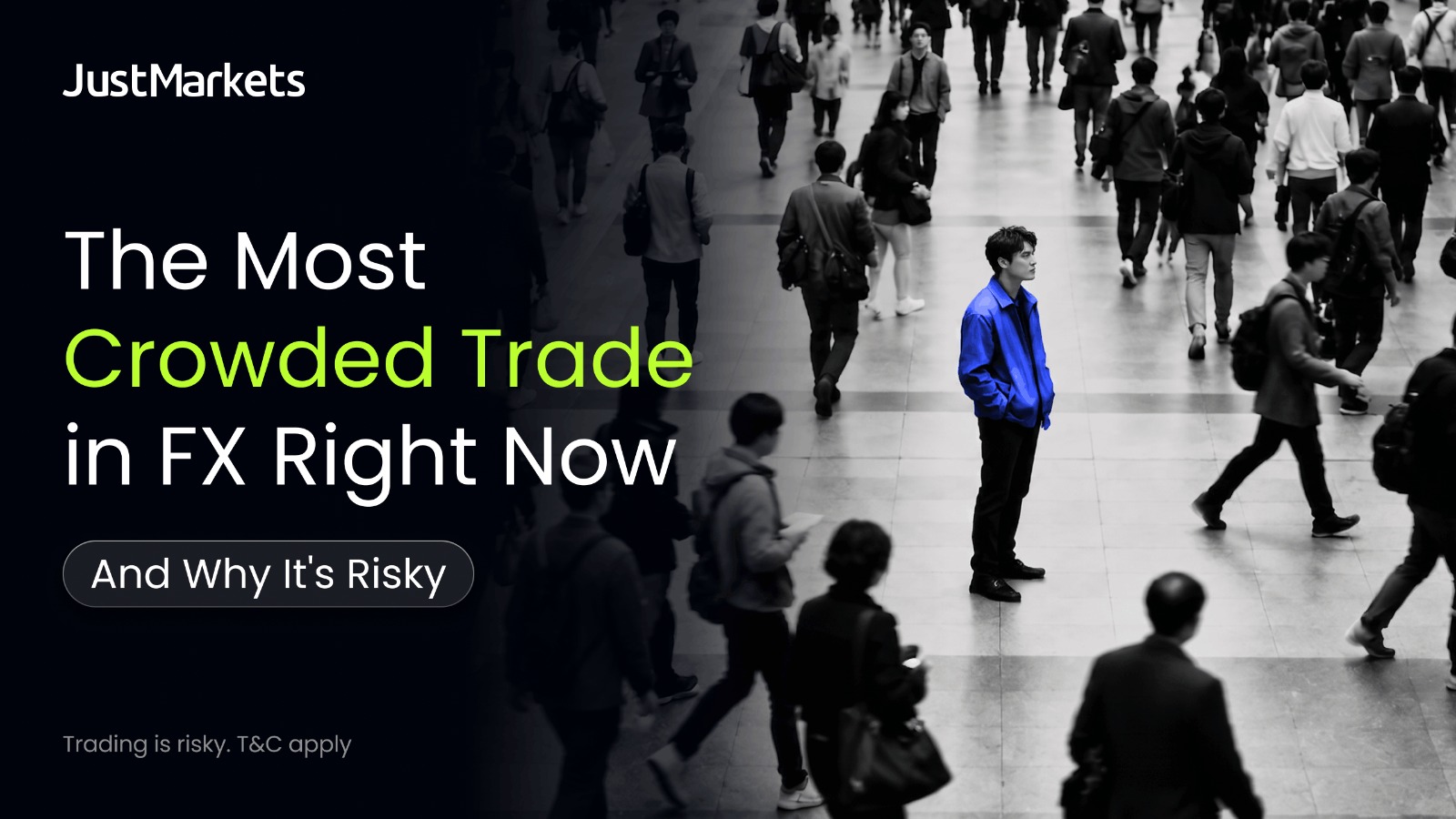
The foreign exchange market is approaching a point where the issue of positioning is gaining in importance relative to the fundamental backdrop. Over the past couple of weeks, some trends have emerged that could be explained by the development of crowded trades, namely those involving USD or carry trades.
Although the fundamentals supporting those positions look pretty strong, traditionally, positioning at very high levels is often associated with surprises.
Positioning Becomes Crucial in FX Markets
As mentioned before, today the dollar is underpinned by higher interest rates and delayed expectations of easing, while the number of carry trades is growing. As a result, traders may face certain risks due to insufficient diversification.
Under crowded trade conditions, traders' decisions may depend not only on the fundamental background or monetary policies. Market positioning may become an additional important factor.
Why Crowded Trades May Be Very Problematic
Firstly, it should be noted that a crowded trade isn't necessarily bad, as it can represent a sound macroeconomic rationale for investment. However, there is always the risk that many market participants trade in one direction, and they may face difficulties in acting in the case of a reversal.
It happens because:
● Traders attempt to get out of the positions together
● Stop-loss orders may be set at the same price
● Liquidity may reduce rapidly when prices move fast
The result is often a cascade effect, in which the price accelerates quickly in the opposite direction.
What Initiates a Reversal in Crowded Positions
Usually, there isn’t a major event that causes a reversal in crowded trades. What happens is that minor events trigger changes that cause traders to realize their positions aren’t going to be profitable anymore, like poor economic reports, slight changes in central bank communications, or geopolitics.
In a situation where traders are crowded on one side, a little shift here or there will have a much larger effect. Once traders start having second thoughts about their trades, they are more likely to initiate reversals at the same time.
This causes the situation to get out of hand quickly due to stop losses being triggered and a drop in liquidity.
Carry Trades: Efficient, but Highly Volatile
As noted earlier, carry trades have historically worked quite effectively in stable environments. Nevertheless, such trades are considered vulnerable, as they may cease functioning during periods of high volatility and uncertainty.
The reason for such a rapid change is that:
● There is a transition from "risk-on" mode to "risk-off"
● Liquidations start rapidly
● Significant corrections are made in carry trades
Accordingly, the role of proper management becomes increasingly important under such conditions.
Reasons Why This Cycle Seems Unique
In contrast to previous cycles, the current economic environment features high geopolitical risk, persistently rising inflation, and ambiguity about the direction of monetary policy.
The above makes the markets more susceptible to positioning problems. The traders do not just react to news. Their emotions play a crucial role as well.
Execution Is Crucial
These days, the quality of trading conditions and execution may negatively affect traders' activities in the market. For instance, there may be slippage, a widening of the spread, and delays in order execution.
Thus, traders have to pay attention to trading conditions when markets become crowded.
For instance, users of JustMarkets platforms can execute their transactions quickly and experience high liquidity across more than 260 financial instruments. This is achieved because traders use MT4 or MT5, which allow them to track their trades and set stop losses instantly.
Moreover, JustMarkets offers flexible trading conditions, leverage up to 1:3000, and positions starting from 0.01 lot, allowing traders to manage their exposure more flexibly and adapt position sizes to their strategy.
How Should Traders Act in Current Circumstances?
Nowadays, traders' primary task is related to proper risk management, as many experienced traders typically focus on several issues, namely:
● Not overexposing themselves to the prevailing macroeconomic story
● Analyzing various indicators of market positioning and sentiment
● Setting stop-loss orders in case of a downtrend
● Anticipating higher volatility and faster movements
Thus, with this knowledge of the importance of positioning, traders may find it easier to cope with existing market conditions.
What This Means for Traders
It happens that the market becomes crowded quite regularly, and this situation implies that risk levels rise as well. Overcrowding increases the likelihood of sharp, sudden reversals. In this way, traders are expected to pay closer attention to execution and risk management.
Risk Warning: Trading financial instruments involves significant risk and may not be suitable for all investors. Market conditions can change rapidly, and losses may exceed deposits. This article is for informational purposes only and does not constitute investment advice.