Shafaq News
A decade of papal audiences, carefully chosen giftsdepicting coexistence on Kurdish soil, and a sustained presence in one of theworld's most symbolically loaded capitals has produced one measurable outcomefor Nechirvan Barzani and the Kurdistan Region of Iraq he leads: recognition inRome, and a sustained effort to keep it that way.
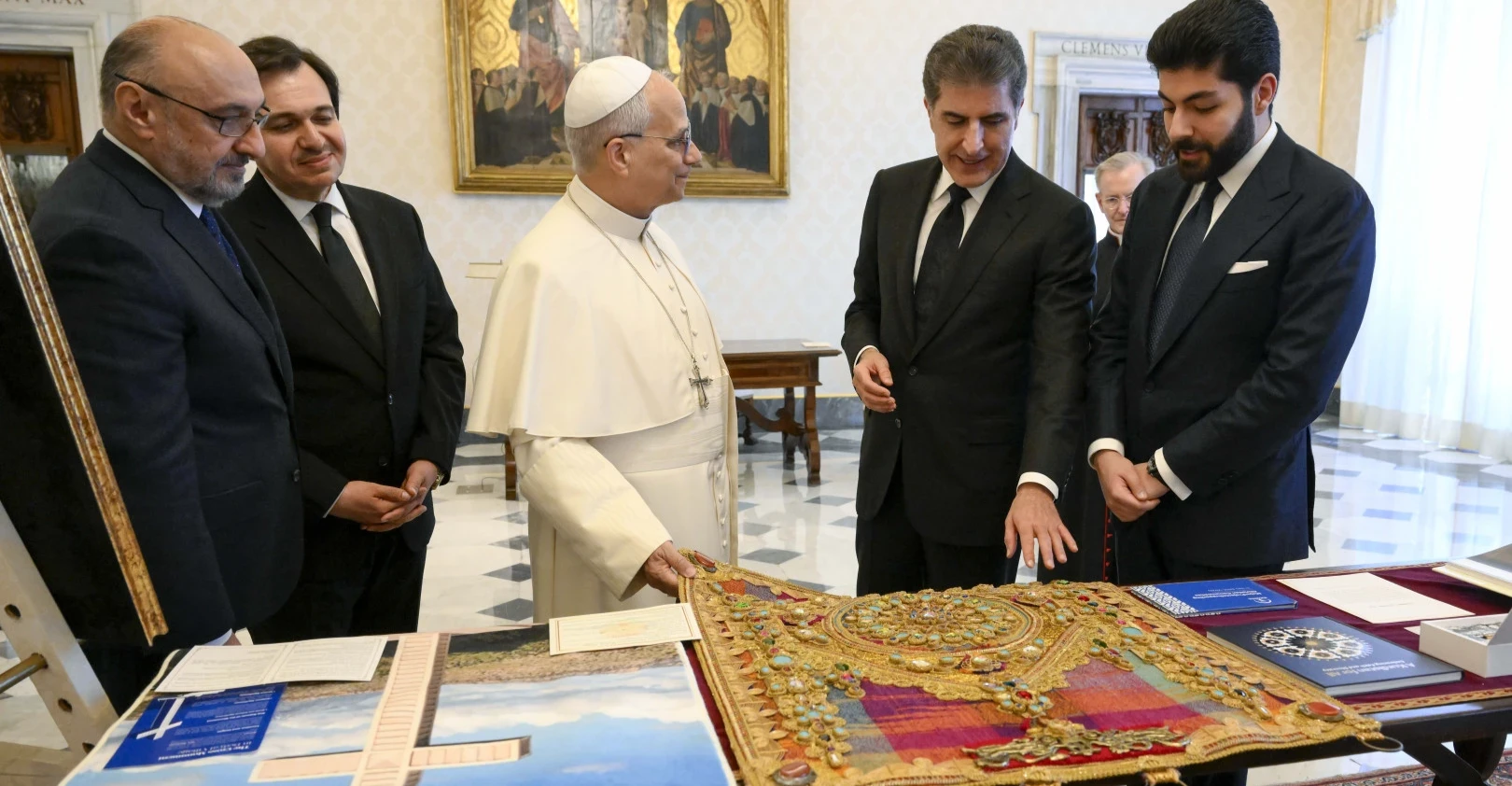
During his meeting with Pope Leo XIV on May 18, Barzaniextended a formal invitation for the Pope to visit Iraq and the KurdistanRegion, reaffirmed that Christians and other religious communities are anessential part of the Region's history and future, and presented gifts,including a painting depicting a cross in Bedyal* village and a paintingsymbolizing coexistence. The meeting followed the pattern of its predecessorswith enough precision to suggest the messaging has been standardized. Whatchanges between visits is the regional pressure under which the imagery isproduced, and the urgency with which Erbil needs Western attention to remainstable.
Pattern Built on Crisis
The relationship between Erbil and the Vatican was notestablished through formal diplomacy, but built incrementally, using eachregional crisis as an occasion to deepen the connection and each period ofrelative calm to institutionalize it.
Barzani, then serving as Prime Minister, met Pope Francis atthe Vatican on March 2, 2015, at the height of the ISIS crisis, to discusssteps the KRG was taking to ensure a peaceful environment for displacedcommunities. Hundreds of thousands of Christians and Yazidis from the NinevehPlains were sheltering in Kurdish territory, and the Peshmerga was the onlyforce standing between ISIS and Erbil. He returned on January 12, 2018, asISIS's territorial defeat was consolidating, shifting the conversation fromemergency to institution-building. In December 2018, Cardinal Pietro Parolinvisited Erbil and praised the Region's role in providing for refugees. PrimeMinister Masrour Barzani met the Vatican's Council of Justice in February 2020.
The relationship's most significant moment came in March2021, when Pope Francis made the first-ever papal visit to Iraq, met withNechirvan and Masrour Barzani in Erbil, then proceeded to Mosul and Qaraqosh,and celebrated Mass for 10,000 people at the Franso Hariri stadium.
The visit gave the Kurdistan Region something no bilateralmeeting could replicate: the image of the head of the Catholic Church onKurdish soil. When Francis died in April 2025, Nechirvan Barzani attended thefuneral at St. Peter's Square, maintaining continuity across the transition andensuring Erbil was present at the moment a new pontificate began.
The Visit That Set the Mold
The most direct predecessor to the current trip wasBarzani's April 2023 Vatican visit. He met Cardinal Parolin, where discussionscentered on Christian minorities in Iraq, then met Pope Francis at theApostolic Palace, where the two discussed a possible future papal visit to theKurdistan Region. Barzani presented a painting illustrating coexistence betweenthe Region's diverse communities, the same visual argument, to the sameinstitution, carried forward three years later to a different pope.
The 2023 visit took place while the Kurdistan Region wasnavigating a severe budget crisis with Baghdad and a protracted governmentformation process. Neither was resolved by the trip, as the budget disputecontinued, and the government formation stalled. The visit renewed Vaticanattention to Iraqi Kurdistan's stability —a real outcome, though a symbolicone, at a moment when Erbil needed something more tangible.
Same Painting, Harder Room
The current visit carries the same institutional content asits predecessors but arrives under considerably more pressure. The US-Iran war,the Strait of Hormuz crisis, Iraq's new government formation under Prime MinisterAli al-Zaidi, and ongoing regional volatility give the stability andcoexistence messaging an urgency it did not carry in 2023.
Erbil, through President Barzani, is presenting to theVatican in May 2026 the same argument it has been making since 2015: a stable,coexistence-oriented enclave in a region becoming less stable and lesstolerant. Whether an argument that has remained consistent across a decade isevidence of strategic clarity or of limited options is a dilemma the visitsthemselves do not resolve.
The disputes with Baghdad persist, and the budget crisisrecurs. Barzani is not unaware of what Rome can and cannot deliver: no papalaudience resolves a budget dispute, and no painting of coexistence rewrites aconstitutional arrangement. But for a region whose leverage in Baghdad isconstrained and whose options in the West are limited, maintaining a steadypresence in the Vatican's consciousness may be the most available form ofcapital. He has spent a decade making sure Erbil never loses it.
* A small village in the Mergasor District in the ErbilProvince. It is one of the oldest Christian settlements in the Barzan area.