Shafaq News-Baghdad
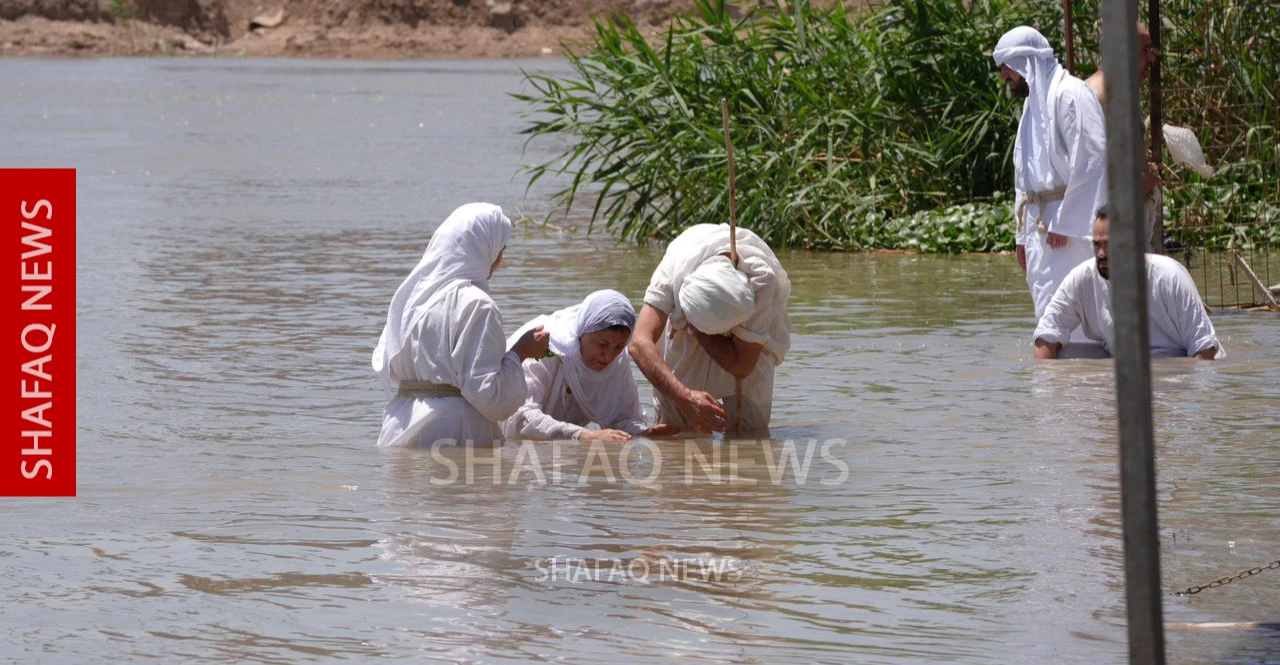
Dressed inwhite and wading into flowing water, Iraq's Mandaean community joined Mandaeansaround the world Sunday in marking Dihba Idimana (Dehwa Daimana) —the GoldenBaptism feast— under mild spring skies.
Baptism is thecentral pillar of the Mandaean faith, obligatory from birth and repeatedthroughout a believer's life. On this occasion, community members gather at theMandi, the Mandaean temple, to undergo the baptismal rite and prepare Thwab, aritual meal of atonement offered on behalf of the dead. The feast commemoratesthe baptism of the Prophet John the Baptist, Yahya ibn Zakariya, who holds therole of central prophet in the faith. It is observed as a day of spiritualpurification, cleansing the soul of all sin, according to Mandaean religiousbelief.
The rite itselfrequires the baptized to enter flowing water alongside a clergyman who recitesscripture throughout the ceremony. All participants, men, women, and children,wear a white garment specific to the occasion called the Rasta.
Mandaeanism isone of the world's oldest monotheistic religions. Its liturgical language isAramaic, the same language used in its holy scripture, the Ginza Rabba, meaning"the Great Treasure" in Arabic. The text contains the scriptures ofthe Prophet Adam: its first section addresses the creation, the teachings ofthe Eternal Living God, and the struggle between good and evil; its secondconcerns the fate of the soul after death, its journey from the body to theworld of light, and the divine reckoning it faces. The Ginza Rabba wastranslated into Arabic under the linguistic supervision of the late poet AbdulRazzaq Abdul Wahid.
Iraq's Mandaeancommunity has faced sustained hardship over recent decades, driving themajority of its members to emigrate or to relocate from southern Iraqi citiesto the Kurdistan Region. An estimated 10,000 to 20,000 Mandaeans remain in Iraqtoday —a fraction of a once-larger presence— with Erbil receiving thousands ofthose who stayed, opening a Mandi for their worship and becoming home tohundreds of Mandaean goldsmiths. Gold-working is the community's traditionaland predominant trade.
Migration wavesbeginning in the late 1990s have dispersed the community across Sweden,Germany, Australia, and the United States, where members have establishedMandis, obtained official recognition, and secured the legal right to practicetheir rituals and meet their religious needs.