
WASHINGTON (Hatha al-Youm) – While the world remains occupied with the sudden transition of territorial control from the Syrian Democratic Forces (SDF) to the Syrian Army, security data and U.S. legislative documents indicate that these events are part of a deliberate execution of "security engineering". This strategy aims to prepare the ground for a critical U.S. deadline set for just three weeks from now.
Intelligence sources report that the current 96-hour truce in eastern Syria serves as a practical cover to finalize the complex issue of "ISIS prisons". This serves as a precursor to implementing a mandatory roadmap issued by the U.S. Congress, directing the Department of Defense (Pentagon) to establish a new partnership with Damascus.
A Binding Mandate
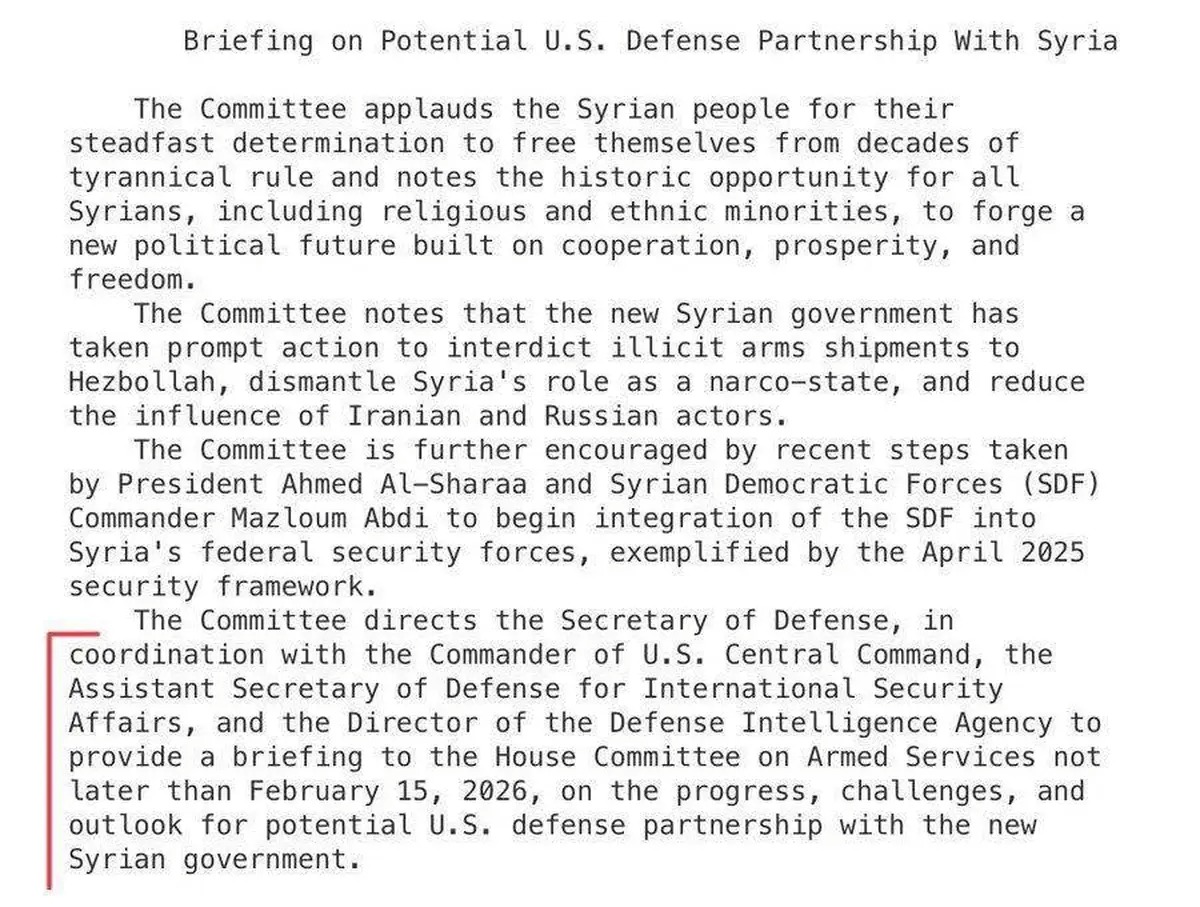
The document, originally issued by the U.S. House Armed Services Committee last August and now forcefully resurfacing, represents a binding legislative directive.
It requires the U.S. Secretary of Defense—in direct coordination with the Commander of U.S. Central Command (CENTCOM) and the Director of the Defense Intelligence Agency (DIA)—to provide a comprehensive briefing to the committee no later than February 15, 2026.
The document explicitly mandates an assessment of the "progress, challenges, and outlook for a potential U.S. defense partnership with the new Syrian government" led by Ahmed Al-Sharaa.
For the first time, Washington has tied this partnership to specific conditions that Damascus has already begun implementing, summarized as follows:
Taking immediate action to interdict illicit arms shipments (seemingly a reference to Iranian-aligned forces).
- Ending Syria's role as a "narco-state" by dismantling the Captagon trade.
- Reducing the influence of competing actors, specifically Iranian and Russian entities.
- The document literally specifies the "integration of the Syrian Democratic Forces (SDF) into Syria's federal security forces," applauding the initial steps taken by President Ahmed Al-Sharaa and SDF Commander Mazloum Abdi in this context.
Removing the "ISIS Card" Security analysts link the February 15 briefing deadline to the massive acceleration in transferring ISIS detainees from Syria to Iraq, currently underway under the cover of the truce.
Washington views the presence of thousands of dangerous foreign fighters under the guard of a local force (the SDF)—which now faces the threat of dissolution or collapse—as an unacceptable threat to national security.
This situation remains a primary obstacle to passing a "defense partnership" with Damascus through Congress.
A U.S. official confirmed that the transfer process, involving approximately 7,000 detainees and conducted with high-level coordination between CENTCOM and Baghdad, aims to "clear all issues" east of the Euphrates. This move withdraws the final card that granted the SDF international legitimacy, making their subsequent integration or dismantling an inevitable conclusion aligned with the new U.S. vision.
Strategic Coordination U.S.-Iraqi coordination, highlighted by the meeting between Prime Minister Mohammed Shia al-Sudani and Admiral Brad Cooper, reflects a shared concern that any delay in finalizing these matters could jeopardize the timeline dictated by the document.
Reports indicate that the "new" Damascus is working strictly according to this U.S. timing. Establishing state control over borders and crossings—largely achieved through the surrender of local tribes—is a prerequisite for the Pentagon to deliver a positive report to U.S. lawmakers.
According to a strategic reading of the situation, the conclusion of this "transfer truce" and the closure of the prison files in the coming days will officially signal the end of the era of "sub-alliances" in U.S. strategy.
It marks the beginning of direct engagement with the "central state" in Syria. This explains the absolute U.S. silence regarding the Syrian Army's advance, which appears to be moving within "rules of engagement" agreed upon behind closed doors to ensure all parties reach the February deadline with a new reality on the ground.