
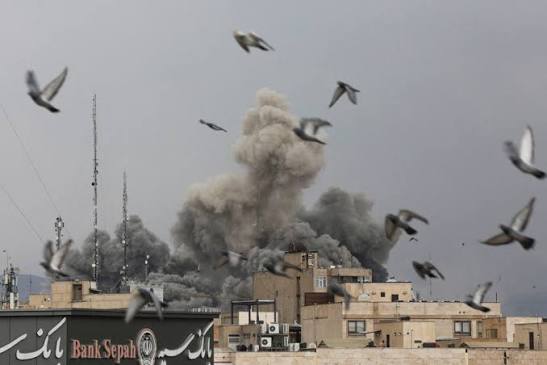
Informed sources said that U.S. President Donald Trump could announce a truce or a tactical ceasefire in direct military operations with Iran at any moment. However, according to these sources, such a move is unlikely to stop Tehran’s retaliatory strikes, which are rapidly expanding to target Gulf states and Kurdish opposition groups.
The sources, speaking on condition of anonymity, stated that the Trump administration is weighing a unilateral de-escalation to prevent a global energy meltdown. Nevertheless, the Iranian military leadership continues to view Gulf states hosting U.S. bases, as well as armed Kurdish factions in Iraq, as legitimate targets not covered by any prospective deal with Washington.
On the ground, it is said that Washington and Tel Aviv are increasingly relying on opening an internal land front to destabilize Tehran. Intelligence reports indicate high-level coordination between the CIA and Iranian Kurdish opposition groups based in the Kurdistan Region of Iraq (KRI). Movements of Kurdish fighters have been tracked toward western Iran, specifically near the city of Mariwan.
In a pre-emptive move that signals a disregard for any potential U.S. truce, Iran’s Khatam al-Anbiya headquarters announced on Thursday heavy ballistic missile and drone strikes targeting the headquarters of Kurdish opposition parties in Sulaymaniyah, Iraq. Tehran maintains it will continue to strike separatist hubs to eliminate threats along its western borders.
Parallel to the Kurdish front, Iran is widening its response to include U.S. interests and critical infrastructure in the Gulf as regional leverage. Military reports confirmed that Tehran launched dozens of ballistic missiles and drones toward key bases in the UAE, Qatar, Kuwait, Bahrain, and Saudi Arabia.
The attacks, despite being intercepted by Gulf air defenses, have resulted in 13 deaths, including 7 civilians, and a temporary suspension of operations at Saudi Arabia's Ras Tanura refinery.
Furthermore, Tehran remains firm on its closure of the Strait of Hormuz, which has slashed tanker traffic by 90%, causing a spike in global energy prices and maritime insurance costs. Sources emphasize that the Revolutionary Guard (IRGC) has decoupled its regional response from the direct confrontation path with Washington.