
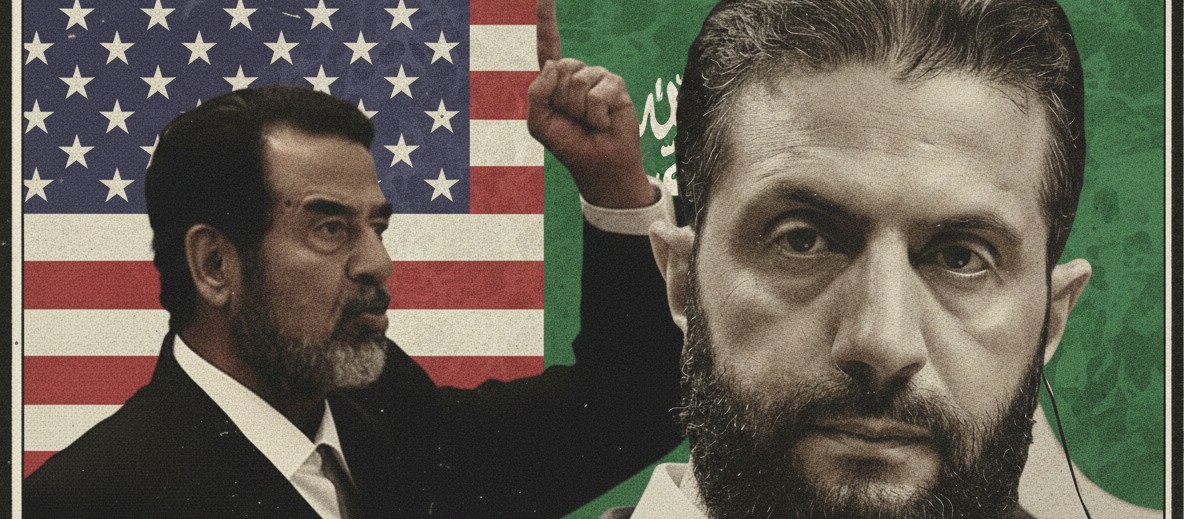
It is a delusion to believe that nations are built on foundations of friendship, good neighborliness, or any moral compass. Instead, they are built on a far more cynical and cunning rule: "A regime that fears a regime." This is, quite simply, the doctrine of the Washington kitchen.
U.S. policy does not seek neighbors who respect one another; it seeks a neighbor who feels for his neck every time he glances across the border. It thrives in an atmosphere poisoned by "uncertainty," where proxy deals flourish and generous rewards are dispensed for those who achieve a rapid rise to power.
The region has entered an era of "political leases." Today, America does not grant permanent deeds of ownership; it distributes rewards with fixed ceilings and ruthless expiration dates. Any leader, transitional president, or "de facto commander" who suddenly finds himself atop the throne must realize he is not there because of military genius, but because he cashed a "security check" at the right time and place.
Al-Shara’ and the Palace Intrigue
What recently unfolded in Syria is no exception. The abandonment of the Syrian Democratic Forces (the Kurds, certainly) is the latest model of this "reward policy." Ahmed al-Shara’ (Golani), who shed his Al-Qaeda cloak to don the suit of a "statesman," did not reach Damascus until he had meticulously arranged his many cards behind the scenes through master security mediators.
Insiders speak of "great services" served on a silver platter to international intelligence agencies. Even ISIS has frequently hinted that Baghdadi's head was the price Golani paid for a "stay in the Palace"—a stay with a very specific expiration date.
Golani, the ultimate "man of deals," invested his years in the Idlib pocket to transform his faction into an army and his "Salvation Government" into an authority, waiting for the "Grand Prize" to ripen. Today, he aspires to be the Syrian "Saddam Hussein": the strongman who claims to contain chaos and suppress extremism, but a version that is a "loyal friend" to the White House—one who never forgets a favor and never deviates from the script. He justifies this by a twist of fate: "His father’s name was Hussein, and my father’s name is Hussein!"
The Man of Shadows
In reality, Al-Shara’ was never an ideological fighter; he was a man of shadows who mastered the art of forgery and the manipulation of identities. Recent history bears witness to how his greatest deception was played out against Iraq and its people. He assumed an Iraqi persona, was imprisoned under an Iraqi name and nationality, and appeared masked on satellite channels using aliases and fabricated titles, manipulating facts under the guise of being a "son of the land."
This disguise was not merely for security; it was the embodiment of his true role as a top-tier intelligence asset embedded within the guts of extremist organizations—a master engineer of internal subversion. Today, Al-Shara’ is rebranding himself as the Syrian Saddam Hussein, leaning on that expertise in managing loyalties and manufacturing fear. He knows well that power in this part of the East is not founded on principles, but on a superior capacity for deception and brutality under the cover of grand deals blessed in dark rooms.
Sunni Centralism vs. Shia Centralism
The American game may go beyond merely installing a proxy. Why? Because the upcoming vision is based on creating a sharp polarization: a rising "Sunni Centralism" in Damascus facing a rooted "Shia Centralism" in Baghdad. Between them, there are no borders of peace, but rather a "single hair" of anxious tension.
Washington wants Damascus and Baghdad to remain in a state of constant anticipation, where fear is the sole driver of policy and subservience to the West is the only refuge for survival. Both will need America. Thus, these capitals continue to fall for American ploys as they have since the dawn of time. "Ya ayb al-shoum" (What a shame), as we say in Damascus.
Iraq’s Coming Woes
In the midst of these difficult labors, one can only say: "May God help the next ruler of Iraq." He will find himself face-to-face with bitter obligations and inevitable woes. As Iraq watches the new Sunni rise in its western neighbor, it will be forced into a spiral of self-defense or a highly unlikely preemptive strike—a spiral meticulously designed by Washington to ensure everyone remains under the "umbrella" it provides.
The "Pax Americana" being promoted on the horizon is not peace in a moral sense; it is a forced stability cemented by deals. This kind of peace does not pass through ballot boxes, but through intelligence operations rooms. It is a peace that will take a long time to be digested—if at all—and as history has proven, it will demand a great deal of blood. Blood spilled just to stabilize the chairs of reward.
the American reward system never stops. Another time and another era may come, waiting for something else to be cooked behind the curtain for someone else, in exchange for a certain policy, to bring a different person to power...
The seats in the American waiting room are always reserved for those who provide the greatest service.
To be continued...